
Will County Court Records After Arrest
Court records after a jail arrest in Will County are handled through the Will County Circuit Clerk, public access pages, and iPublic. The Circuit Clerk maintains records of criminal, traffic, civil, and other cases filed and heard in Will County. For a person who was just booked into the Adult Detention Facility, the jail roster may show booking charges, a docket number, a court date, and a courtroom. The court record is the more important source once the prosecutor files, amends, or dismisses charges.
The custody side and the court side should not be merged. Jail booking details, bond fields, housing status, and booking photos come from the sheriff's system. Filed charges, docket events, document copies, court dates, and dispositions come from the Circuit Clerk and court-access channels. For the custody side, use Will County jail inmate records. For booking photos, use the Will County jail mugshots page. The court case should be checked separately because charges can change after the arrest.
Illinois law also gives the pathway structure. Under 725 ILCS 5/109-1, the arrested person is brought before the court for an initial appearance, where the judge informs the person of the charge. Under 725 ILCS 5/111-2, formal felony prosecution is by information or indictment, while other prosecutions may proceed by indictment, information, or complaint.
Will County Court Case Access
The main online path is the Circuit Clerk public access page, which sends users to iPublic for free court case lookup. The access is useful but limited. The Clerk's public-access language says the online lookup is not the full official court record, and more complete access or document images may require courthouse terminals, physical files, or copy ordering.
The iPublic portal has an agreement and email security-code gate before a user reaches the case search area. The research did not inspect post-login fields without a security-code session, so exact defendant and case-number search fields should not be invented. The pre-access screen is still important because it controls how the public reaches Will County court records after a jail arrest.
| Field Label | Type | Required | Options / Format Notes |
|---|---|---|---|
| AGREED / acknowledgement | Checkbox | Yes | User must accept the iPublic user agreement. |
| Email address for security code | Email text | Yes | Temporary email accounts are prohibited by the portal terms. |
| Submit | Button | Yes | Sends agreement and email for the security-code step. |
| reqip | Hidden | Not applicable | Filled by the portal's IP lookup script. |
| mode | Hidden | Not applicable | Observed value A, with validation also referencing security-code mode S. |
The iPublic access screen shows why Will County court records after an arrest are not the same as a quick open web table. The user must agree to terms, provide an email address, and use a session security code.
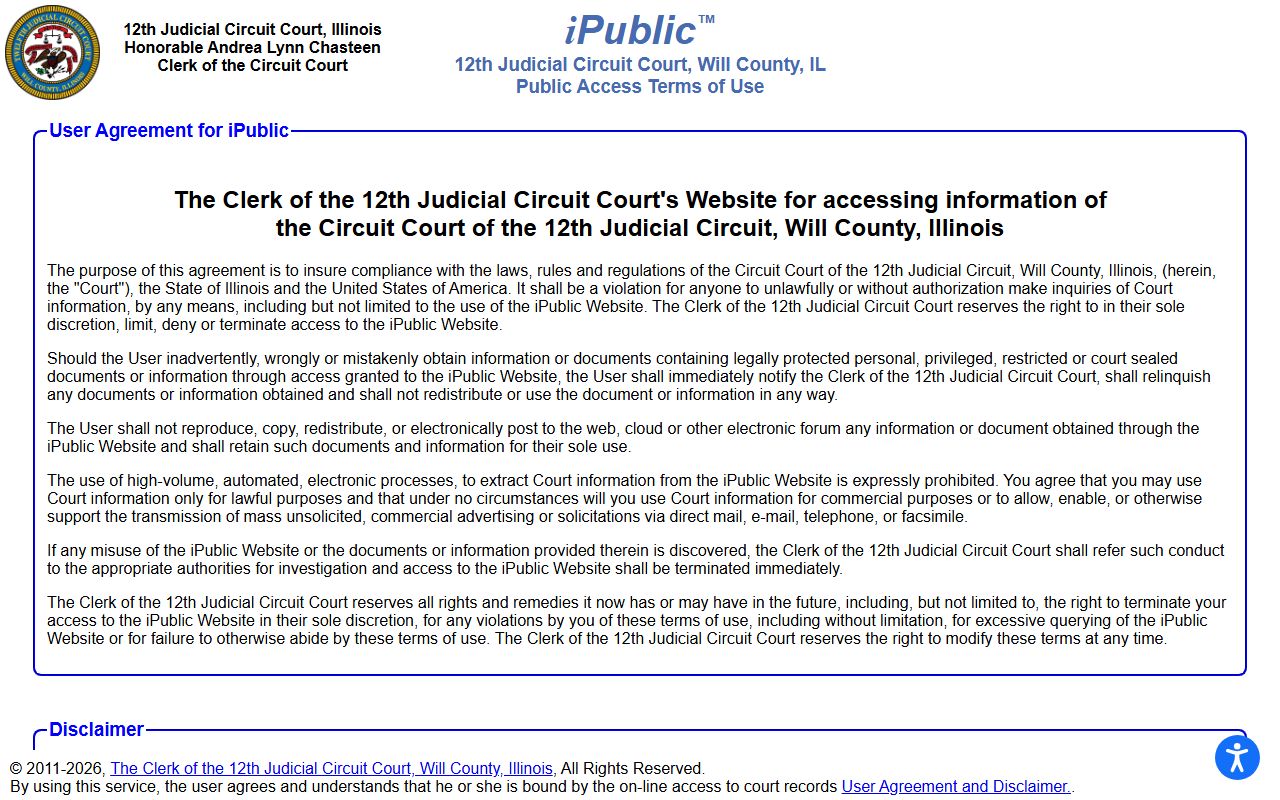
That gate also explains why court-file copies and official-document review may need the Clerk's copy process or in-person records access.
Find Court Records After Arrest
Start with the clearest identifier. A docket number from the jail roster or bond paperwork is more exact than a name search. If no docket number appears, use the person's legal name and check the Circuit Clerk's public access options. The roster's court date can help, but the official court schedule and filed case record should be confirmed with the court source.
- Check the sheriff roster for a docket number, court date, charge text, and booking date.
- Open Circuit Clerk public access and pass through the iPublic agreement and email code screen.
- Search the court case using the available post-login fields and compare names, dates, and case numbers carefully.
- Read the charge list, case events, hearing dates, and disposition fields rather than relying only on booking text.
- Order copies through the Clerk's i2File process or use courthouse terminals if document images are needed.
iPublic downtime matters for late-night searches. The research notes posted downtime Monday through Saturday from 11:50 p.m. to 3:00 a.m. CST, and Sunday 11:00 p.m. to Monday 5:00 a.m. CST. If the portal is unavailable during those windows, wait for the access window to reopen or use the Clerk's customer-service channels.
Charges After Jail Arrest
After a Will County arrest, the State's Attorney's Office reviews cases presented by law enforcement. Its Criminal Division handles felony and misdemeanor cases, and the Complaint Office reviews cases for possible charges and coordinates grand jury proceedings. That review is the bridge between an arrest entry on the jail roster and the formal court record.
A booking charge is an intake or arrest-side label. A filed charge is the charge carried in court. The filed case can add, remove, amend, reduce, or supersede the booking charge as the prosecutor reviews evidence and the court process moves forward.
| Document | Who Uses It | Common Role | Why It Matters |
|---|---|---|---|
| Complaint | Officer or prosecutor | Starts many criminal cases or alleges the offense after arrest. | Often the first charging document tied to arrest and initial appearance. |
| Information | Prosecutor | Formal felony prosecution without grand jury indictment where permitted. | Can replace or refine the booking charge in the court record. |
| Indictment | Grand jury | Formal accusation returned after grand jury proceedings. | May supersede earlier complaint or information language. |
Will County Charge Status
Charge status describes where a filed charge stands in the court record. A pending charge is not a conviction. A dismissed charge is not the same as a guilty plea. A reduced or amended charge means the prosecutor or court has changed the charge from its earlier form. Reading court records after a jail arrest requires checking each count, not just the case caption.
| Status | What It Means | Where to Confirm |
|---|---|---|
| Pending | The charge remains open and has not reached a final disposition. | iPublic docket and court hearing entries. |
| Amended | The charge text, level, count, or statute was changed after filing. | Filed documents, docket events, and Clerk copies. |
| Reduced | The prosecutor or court moved the charge to a lower grade or different offense. | Disposition entries and charging documents. |
| Dismissed | The charge was ended without a conviction on that count. | Disposition and order entries. |
| Superseding | A later charging document replaces or overtakes an earlier one. | Information or indictment filings. |
| Convicted | The case ended in a guilty plea, verdict, or finding on that charge. | Final judgment, sentencing, and docket disposition. |
Note: A jail roster charge can be useful for identification, but the court docket is the better source for filed charge status.
Bond After Jail Arrest
Illinois changed pretrial release practice in 2023, so older cash-bail wording and roster fields should be read with care. Will County sheriff pages still publish practical instructions for cases where payment is authorized or required by the court. The public inmate profile can show Total Bond Amount, Total Bail Amount, and a bond table, but a zero-dollar field or no data does not always mean the person can leave.
Will County's sheriff family/friends materials say bail may be posted at the Adult Detention Facility when allowed, with cash and major credit cards accepted for authorized payments. The Sheriff bail and commissary page says online bail payments are not currently accepted and warns against Venmo, Cash App, Zelle, or calls claiming to demand bail on behalf of the Sheriff's Office.
| Release Term | Plain Meaning | Records Caveat |
|---|---|---|
| Pretrial release | Court-ordered release with conditions instead of jail custody. | Check court orders, not just roster bond fields. |
| Cash or card payment | Payment where the court has authorized a money condition. | Follow current Will County payment instructions. |
| Detainer or hold | Another agency or order can keep the person in custody. | May block release despite local bond language. |
| No-release status | The court or another legal authority does not allow release yet. | Requires court or jail confirmation. |
Warrants Before Court Records
A warrant may be the event that leads to arrest, booking, and then court records. The Sheriff's Warrant Unit maintains warrants issued in Will County, including warrants from the Sheriff's Department and police departments inside county boundaries. The official sheriff site links to the Will County warrant list, which shows name, last location, offense, date issued, and a details link.
Warrant records and court records overlap but are not identical. A warrant authorizes arrest. A court docket tracks the case after filing. The warrant FAQ says the Sheriff's Office cannot give warrant information over the phone, so use the online warrant portal, local police, court verification, or in-person turn-in guidance as appropriate.
Under 725 ILCS 5/107-9, an arrest warrant may issue after complaint and oath or affirmation. After the arrest, initial appearance rules control the court side.
Charges Versus Convictions
Court records after a Will County jail arrest may show charges long before a conviction exists. A charge is an accusation. A conviction is a final result reached by guilty plea, verdict, or finding. This distinction matters for anyone reading an iPublic docket, sheriff roster charge, warrant detail, or criminal-history report.
| Point of Comparison | Charge | Conviction |
|---|---|---|
| Stage | Filed accusation or count in the case. | Final outcome after plea, verdict, or finding. |
| Proof level | Based on charging review and legal sufficiency. | Requires conviction standard through court process. |
| Can change? | Yes, charges can be amended, reduced, added, or dismissed. | Can be appealed, vacated, sealed, or expunged only through legal process. |
| Best source | Charging documents and docket entries. | Judgment, sentence, disposition, or approved criminal-history record. |
Sealed Expunged Court Records
Illinois law allows some records to be sealed or expunged under eligibility rules in 20 ILCS 2630/5.2. This can affect whether a Will County arrest, charge, booking link, or case detail remains publicly visible. Eligibility depends on the disposition and statutory limits, so it should not be guessed from a roster entry alone.
| Point of Comparison | Sealed | Expunged |
|---|---|---|
| Public visibility | Hidden from most public searches. | Removed or treated as though it did not exist for many purposes. |
| Government access | Some agencies may retain limited access. | Access is more restricted, subject to law. |
| Typical use | Qualifying arrests, charges, or convictions under Illinois rules. | Qualifying non-conviction or other eligible outcomes. |
| How to confirm | Court order and Clerk record status. | Court order and agency compliance with expungement. |
Sealing or expungement does not happen because a person dislikes a search result. It requires a legal process and a court order when the record qualifies.
Court Copies Criminal History
Document copies do not come from sheriff FOIA. The Circuit Clerk's copy process routes court document requests through i2File, and the research notes that copies are uploaded to i2File after fulfillment so the requester can pay, print, or save them. For in-person access, the main courthouse is at 100 W. Jefferson Street in Joliet, and the Nicholson Archive Center is available by appointment for archive records.
Sheriff FOIA is still useful for arrest, incident, booking, and Adult Detention Facility records, but it is not the right path for filed complaints, informations, indictments, motions, orders, or court dispositions. Prosecutor-office records in the custody of the State's Attorney route to the SAO FOIA process, and criminal discovery or victim records may be exempt or restricted.
Statewide criminal-history checks are separate. ISP CHIRP and Illinois State Police UCIA access can provide criminal-history information, but those channels require their own enrollment or fees and do not replace the Will County court docket. Use them only when a statewide background-history channel is actually needed.
Important: Court lookups and roster checks are public-record tools, not FCRA consumer reports for employment, housing, credit, or insurance decisions.